
Total Ankle Replacement in Toledo, Ohio
Preserve Motion. Restore Mobility.
If ankle arthritis has made walking, exercising, or simply getting through the day painful, total ankle replacement may provide lasting relief while preserving natural joint motion.
Dr. Kyle McKray Smith specializes in advanced foot and ankle reconstruction and total ankle replacement for patients throughout Toledo, Bowling Green, and Northwest Ohio.
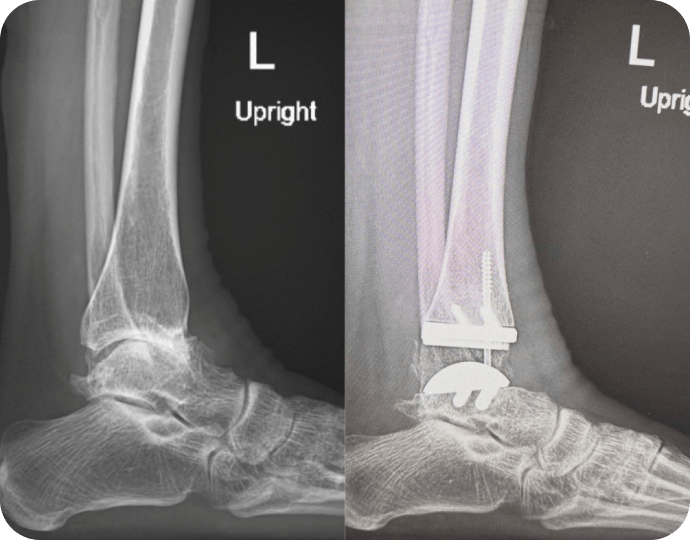
Significant Post-Traumatic Ankle Arthritis
Preserve Motion. Restore Mobility.
If ankle arthritis has made walking, exercising, or simply getting through the day painful, total ankle replacement may provide lasting relief while preserving natural joint motion.
Dr. Kyle McKray Smith specializes in advanced foot and ankle reconstruction and total ankle replacement for patients throughout Toledo, Bowling Green, and Northwest Ohio.
What Is Total Ankle Replacement?
Signs You May Be a Candidate:
- Persistent ankle pain
- Stiffness or limited motion
- Pain after ankle fracture or ankle sprain
- Swelling around the ankle joint
- Pain while walking or standing
- Bone on bone arthritis
- Difficulty participating in work, exercise, or recreational activities
- Arthritis that not improved with braces, injections, therapy, or medications
Every patient is unique. A comprehensive evaluation is necessary to determine whether ankle replacement is the most appropriate treatment option.
Conditions Commonly Treated With Total Ankle Replacement
Post-Traumatic Arthritis
Arthritis that develops after ankle fractures or other significant injuries, often leading to chronic pain, stiffness, and loss of function.
Primary (degenerative) arthritis
Progressive degeneration of the ankle joint that develops gradually over time due to cartilage wear and age-related changes.
Inflammatory Arthritis
Joint damage caused by inflammatory diseases, such as rheumatoid arthritis, that can progressively affect ankle function.
Avascular necrosis
Loss of blood supply to the talus that can lead to bone collapse, severe ankle pain, and advanced joint deterioration.
Total Ankle Replacement vs. Ankle Fusion
Both procedures can provide substantial pain relief for advanced ankle arthritis.
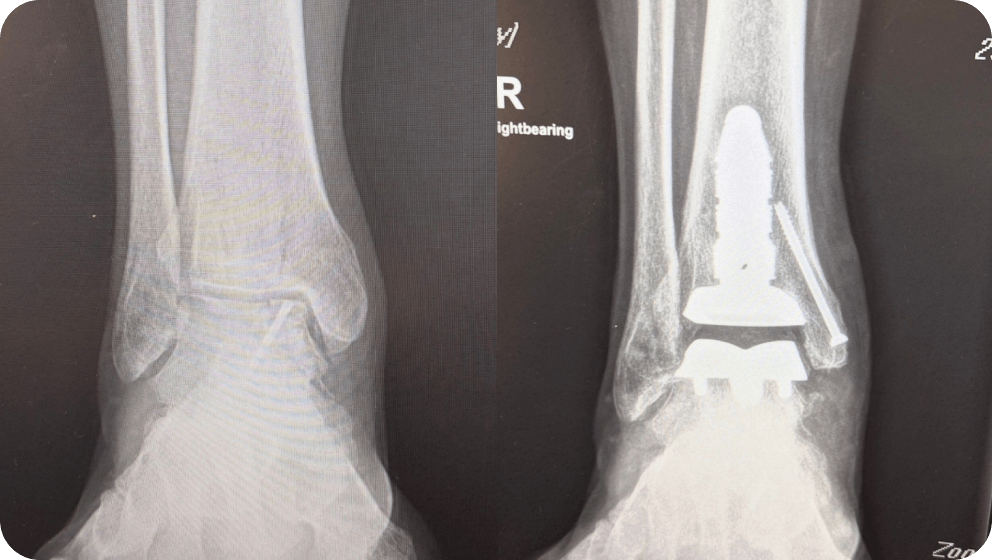
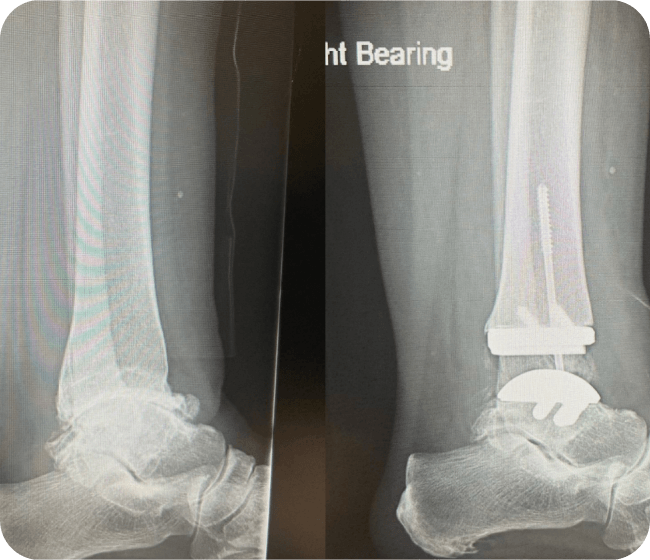
Total Ankle Replacement
- Preserves joint motion
- Supports a more natural gait
- Maintains mobility for many daily activities
- May reduce stress on neighboring joints
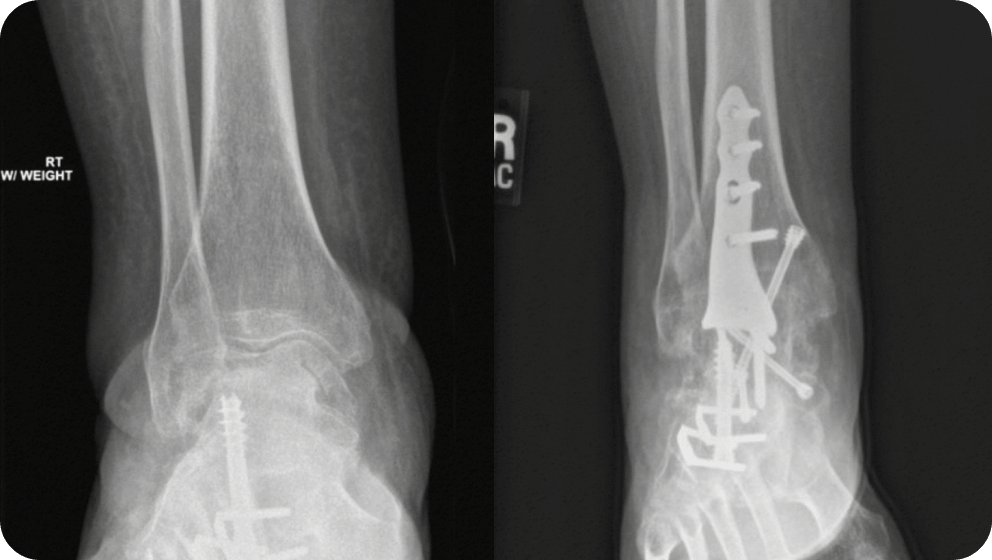
Ankle Fusion
- Eliminates painful joint motion
- Creates a stable, permanent joint
- May be preferred in certain complex cases
Choosing between these procedures requires careful evaluation of your anatomy, lifestyle, goals, and overall health.

Why Patients Seek Total Ankle Replacement
Patients often pursue ankle replacement because they want to:
- Walk with less pain
- Maintain mobility
- Stay active
- Preserve ankle motion
- Improve overall quality of life
For the right patient, total ankle replacement can provide meaningful improvements in comfort and function.
Why Patients Seek Total Ankle Replacement
Patients often pursue ankle replacement because they want to:
- Walk with less pain
- Maintain mobility
- Stay active
- Preserve ankle motion
- Improve overall quality of life
For the right patient, total ankle replacement can provide meaningful improvements in comfort and function.
Am I a Candidate for Total Ankle Replacement?
Not every patient with ankle arthritis requires surgery, and not every patient with ankle arthritis is a candidate for ankle replacement.
During your evaluation, Dr. McKray Smith will consider:
- The severity of your arthritis
- Your overall health and activity level
- Previous injuries or surgeries
- Joint alignment and stability
- Bone quality and surrounding anatomy
- Your personal goals and expectations
Many patients are surprised to learn that modern total ankle replacement may be an option even after years of chronic pain and limited mobility.
The best way to determine whether you are a candidate is through a comprehensive foot and ankle evaluation.
Take the Next Step
If ankle pain is limiting your mobility and quality of life, schedule an evaluation to learn whether total ankle replacement may be right for you.
Take the Next Step
If ankle pain is limiting your mobility and quality of life, schedule an evaluation to learn whether total ankle replacement may be right for you.
Recovery After Total Ankle Replacement
Recovery following total ankle replacement occurs gradually and progresses through several phases. While every patient heals differently, the typical recovery timeline includes:
EARLY RECOVERY (Weeks 0–2)
Then ankle is protected in a splint or cast while the incision begins to heal. During this phase, patients typically remain non-weight-bearing to protect the surgical repair.
Progressive Rehabilitation (Weeks 4–8)
As healing progresses, patients gradually begin weight-bearing in a CAM boot. Physical therapy and guided rehabilitation help restore strength, mobility, and confidence. The goal for many patients is transitioning toward a regular shoe around 8 weeks, depending on individual healing.
Return to Daily Activities
Most patients continue improving over several months as they return to everyday activities with greater comfort and mobility. Although many milestones occur within the first few months, full recovery may take up to one year.
Dr. McKray Smith provides individualized recovery plans designed to support a safe and successful outcome.

Why Choose Dr. Kyle McKray Smith?
His practice serves patients throughout Northwest Ohio and Southeast Michigan seeking specialized care for challenging ankle conditions, including severe arthritis, post-traumatic injuries, and failed prior treatments.
Whether patients are exploring treatment options for chronic ankle pain or considering total ankle replacement, the goal remains the same: restoring mobility, reducing pain, and helping patients return to the activities that matter most.
Dr. McKray Smith Is Board Certified By:


Why Choose Dr. Kyle McKray Smith?
His practice serves patients throughout Northwest Ohio and Southeast Michigan seeking specialized care for challenging ankle conditions, including severe arthritis, post-traumatic injuries, and failed prior treatments.
Whether patients are exploring treatment options for chronic ankle pain or considering total ankle replacement, the goal remains the same: restoring mobility, reducing pain, and helping patients return to the activities that matter most.
Dr. McKray Smith Is Board Certified By:
Frequently Asked Questions
Every patient’s situation is unique. These answers address common questions about total ankle replacement, including who may be a candidate, what recovery involves, and what results patients can typically expect after surgery.
How long does a total ankle replacement last?
Modern total ankle replacements are designed for long-term performance. Current studies demonstrate greater than 90% implant survivorship at 10 years, with ongoing research suggesting excellent durability beyond that in appropriately selected patients.
Is total ankle replacement better than ankle fusion?
Neither procedure is universally better. Both are excellent treatments for advanced ankle arthritis, and the best option depends on your anatomy, activity level, lifestyle goals, and overall health.
How long does recovery take?
Most patients begin progressive weight bearing within the first several weeks, return to many daily activities by 3–4 months, and continue improving for up to one year after surgery.
Will I be able to walk normally again?
Many patients experience significant improvements in walking, comfort, and overall function. While every recovery is different, our goal is to restore the most natural gait possible while reducing pain.
Can ankle replacement relieve chronic pain?
Yes. The primary goals of ankle replacement are to reduce pain, preserve motion, and improve overall function and quality of life.
Can ankle arthritis develop after a fracture?
Yes. Post-traumatic arthritis is one of the most common causes of ankle arthritis and may develop months or even years after an ankle injury.
Can I stay active after ankle replacement?
Yes. Many patients return to an active lifestyle after recovery, including walking, hiking, golfing, cycling, and other low-impact activities.
Am I too old for ankle replacement?
Age alone does not determine whether you’re a candidate. Overall health, bone quality, activity level, and the condition of your ankle are often much more important than your age.
When should I see a specialist?
If ankle pain, stiffness, swelling, or mobility limitations are affecting your daily life, an evaluation may help identify treatment options before symptoms continue to progress.
What if I have already had ankle surgery?
Previous surgery does not automatically prevent ankle replacement. Dr. McKray Smith routinely evaluates patients with complex surgical histories and failed prior treatments.
TOTAL ANKLE REPLACEMENT GUIDE
A comprehensive patient guide covering ankle arthritis, treatment options, implant technology, recovery expectations, and what to expect before and after total ankle replacement surgery.
Explore Related Conditions
Many patients who ultimately benefit from total ankle replacement have experienced chronic ankle pain, previous injuries, or longstanding joint damage. Learn more about these related conditions that may contribute to advanced ankle arthritis and loss of mobility.
Patients with chronic ankle pain, stiffness, and swelling may be experiencing ankle arthritis. Learn about symptoms, causes, diagnosis, and treatment options.
Persistent pain or limited function after previous ankle surgery may benefit from a second opinion and advanced reconstructive treatment options.
PREVIOUS ANKLE FACTURES
Even after a fracture heals, lingering joint damage can lead to chronic pain, stiffness, and post-traumatic ankle arthritis years later.
SEVERE ANKLE SPRAINS & CHRONIC INSTABILITY
Repeated ankle sprains or long-term instability can accelerate cartilage wear and eventually contribute to ankle arthritis.
MALUNION OR NONUNION AFTER ANKLE FRACTURE
When a fracture heals improperly (or fails to heal altogether) it can alter joint alignment, cause chronic pain, and increase the risk of arthritis.
LONG-STANDING ANKLE DEFORMITY
Varus or valgus ankle deformities can place abnormal stress on the joint, accelerating cartilage breakdown and limiting mobility.
OSTEOCHONDRAL (CARTILAGE) INJURIES
Damage to the cartilage and underlying bone may progress over time, leading to persistent pain and degenerative ankle arthritis.
Explore Related Conditions
Many patients who ultimately benefit from total ankle replacement have experienced chronic ankle pain, previous injuries, or longstanding joint damage. Learn more about these related conditions that may contribute to advanced ankle arthritis and loss of mobility.
Patients with chronic ankle pain, stiffness, and swelling may be experiencing ankle arthritis. Learn about symptoms, causes, diagnosis, and treatment options.
Persistent pain or limited function after previous ankle surgery may benefit from a second opinion and advanced reconstructive treatment options.
PREVIOUS ANKLE FACTURES
Even after a fracture heals, lingering joint damage can lead to chronic pain, stiffness, and post-traumatic ankle arthritis years later.
SEVERE ANKLE SPRAINS & CHRONIC INSTABILITY
Repeated ankle sprains or long-term instability can accelerate cartilage wear and eventually contribute to ankle arthritis.
MALUNION OR NONUNION AFTER ANKLE FRACTURE
When a fracture heals improperly (or fails to heal altogether) it can alter joint alignment, cause chronic pain, and increase the risk of arthritis.
LONG-STANDING ANKLE DEFORMITY
Varus or valgus ankle deformities can place abnormal stress on the joint, accelerating cartilage breakdown and limiting mobility.
OSTEOCHONDRAL (CARTILAGE) INJURIES
Damage to the cartilage and underlying bone may progress over time, leading to persistent pain and degenerative ankle arthritis.
TOTAL ANKLE REPLACEMENT GUIDE
A comprehensive patient guide covering ankle arthritis, treatment options, implant technology, recovery expectations, and what to expect before and after total ankle replacement surgery.
Schedule Your Appointment
Serving Toledo, Perrysburg, Bowling Green, and Northwest Ohio.
Call the location most convenient for you to book your visit.
Glass City Orthopaedic & Spine Center
Toledo Location
4235 Secor Rd, Bldg 1, Upper Level
Toledo, OH 43623
Falcon Sports Medicine & Orthopedics
Bowling Green Location
Bowling Green, OH 43402